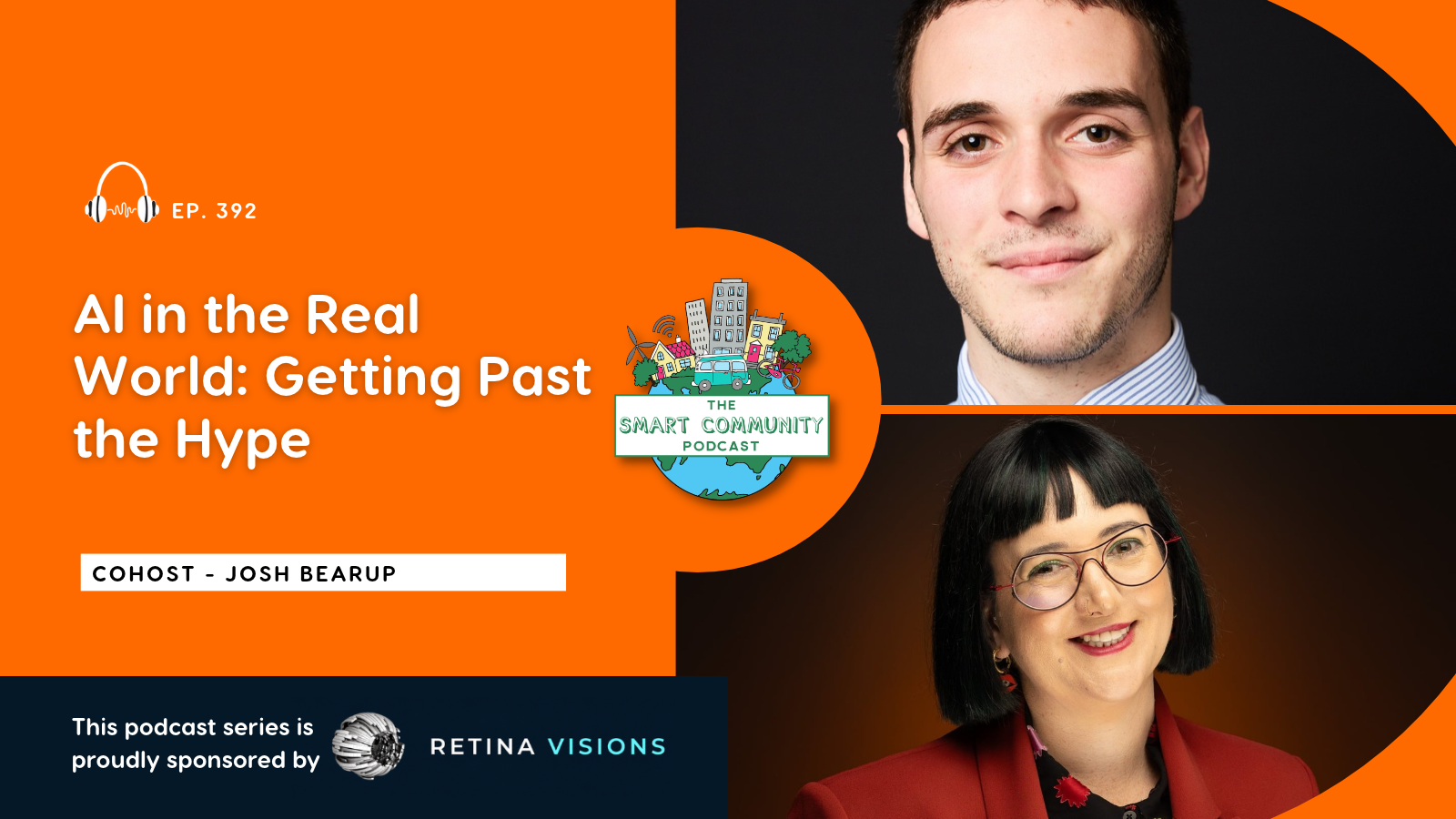
Hi there, smart community friends, and welcome back to another episode of the Smart Community Podcast. I’m very excited because we are starting a brand new series today, a weekly series, until Christmas, and then we’ll see you back in the new year. Now, this series is called AI in the Real World, where we are going to explore real world applications of AI, particularly in Australia, some of the implications and challenges as well, and we’re going to have a diverse range of people on the podcast from a range of different backgrounds, like government, agencies.
We’ll have some tech companies as well, and people thinking in this space. But really, it’s about real world applications. The other thing that is new and different and fun is that we’ll have a co-host on this series as well. He will introduce himself shortly, but his name is Josh Bearup. So I’m excited to bring you this series and, yeah, have a great day everyone.
As always, I hope you enjoy listening to this episode as much as we enjoyed making it.
The AI in the Real World series is proudly sponsored by Retina Visions. Find out more at https://www.retinavisions.com/
What we cover in this episode:
- What the AI in the Real World series sets out to explore
- The difference between deterministic software and non-deterministic AI
- OCR models (Optical Cognitive Recognition) and how they differ from generative AI
- Zoe’s experience building a machine learning model to predict epileptic episodes from EEG data during her Masters of Data Science
- Prompt injection, and the strange new skill of “social engineering” an AI system
- Recent real-world examples of AI agents causing unintended harm, from a queue-jumping gym agent to OpenAI’s Medibank breach
- Josh’s path from a Victorian Government cybersecurity internship to Emerging Technologies Officer
- Zoe’s career journey: civil engineering, flood recovery work in regional Queensland, professional development in South Korea, and founding the podcast
- Why the show shifted from “Smart City” to “Smart Community”
- The role of trust, relationships and human connection in technology adoption
- What responsible, meaningful AI adoption actually looks like in practice
Quote options:
“AI in the real world means we’ve got this new technology with a whole lot of unanswered questions, because it’s something we’ve never had to deal with before.” — Josh
“With AI, you don’t need to pre-program the instructions it’s going to follow. You get to speak to it in natural language, and it will perform tasks and generate outputs in a way that it decides is the right thing to do.” — Josh
“It’s not the gravel, it’s not the machinery, it’s not the technology. It’s the relationships that have the most impact on a project’s success.” — Zoe
“No one selling this technology is going to answer [questions about social good] for us. They’ll do whatever keeps the money coming in. So it’s the people using it, and the people affected by it, who need to look at it with open eyes and decide what they want it to look like.” — Josh
“We need to be human no matter what we’re doing, whether we’re talking about tech or whatever else. We need to keep bringing that back in.” — Zoe
Links:
- RetinaVisions — proud sponsor of the AI in the Real World series
- Episode 391 with Josh Bearup
Connect:
Connect with Josh via LinkedIn.
Connect with me via email: hello@mysmart.community
Connect with My Smart Community via LinkedIn or YouTube.
The Smart Community Podcast is produced by PERK Digital.
This podcast is recorded on the traditional lands of the Kabi Kabi peoples and edited on the lands of the Gaibal peoples. We pay our respects to Elders past and present and extend that respect to all Aboriginal and Torres Strait Islander peoples listening today.