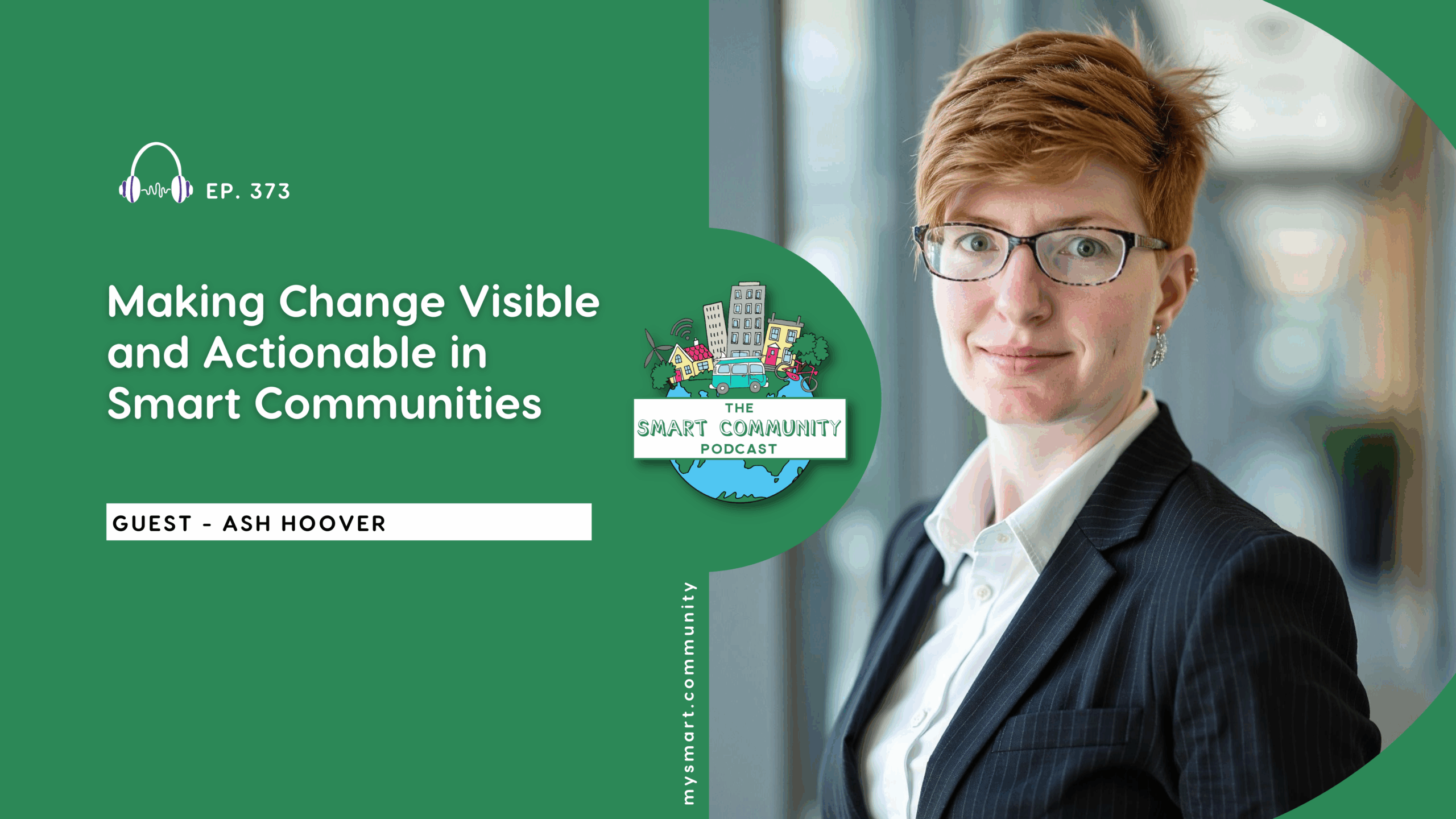
Hi #SmartCommunity friends, in this episode of the Smart Community podcast I have a brilliant discussion with Ash Hoover. Ash is a scientist turned technologist and AI R&D Lead at Planet Labs, an earth imaging company. They work at the intersection of artificial intelligence and earth observation, analysing millions of satellite images to understand how our planet is changing over time.
In this episode Ash tells us about using data visualisation and storytelling to make planetary change visible and actionable. We discuss the power of video maps and animated visualisations, including how time has become a critical dimension in their work.
We talk about cognitive bias in data interpretation, the importance of including diverse voices and perspectives in data storytelling, and the human stories behind the data, from wildfire trauma to the limitations of viewing Earth from space.
We finish our discussion with the evolving relationship between AI and data visualisation, the importance of human-in-the-loop decision making, and how collective humanity has tremendous power when we tell stories that are accessible and actionable. As always, we hope you enjoy listening to this episode as much as we enjoyed making it.
The views and opinions expressed by Ash in this episode are their own and do not represent those of their employer or any organisation they are affiliated with. All discussions are shared in a personal capacity.
What we cover in this episode:
- How Planet Labs uses satellite imagery to make change visible, accessible, and actionable across the entire surface of Earth
- The concept of video maps as an evolution from static maps, showing trends over time
- Making large numbers relatable through analogies, like describing deforestation as 18 soccer fields per minute rather than square kilometers per hour
- The challenge of creating info-dense yet not overwhelming visualisations for busy decision makers and policymakers
- How data visualisations travel beyond their original context and the importance of making them interpretable, properly sourced, and reproducible
- The role of cognitive bias in how we consume and share data on social media, and building trust through transparency
- Why including diverse voices and perspectives is essential to avoid missing big pieces of the story, exemplified by the “Beyond Counting Trees” workshop series
- The deeply personal and human stories behind data statistics, illustrated through a theatrical art piece about California wildfires
- How stories themselves are data, and the potential of combining hard data with emotional human narratives
- The power of live dashboards as team members, creating visceral reactions and collective moments
- Designing for both human and AI audiences in an era where AI agents are increasingly processing and making decisions based on our data
- The importance of keeping humans in the loop for high stakes decisions while recognising when automation can help communities, such as parametric drought insurance
Quotes:
“I like to say that I zoomed out and slowed down because I used to study light matter interactions at a very small and very fast scale, and now I do that in a much bigger picture view, thinking about how we’re all interacting and impacting the planet.”
“The World Resources Institute has estimated approximately 18 soccer fields or football fields per minute are being deforested. I think that summarising a large amount of data and turning it into a short sentence like that can really make it relatable, can make people understand the scale, the speed, and the magnitude.”
“We ourselves are a social neural network making connections across our spheres together and with each other, having more specialised areas where we can’t all dive into everyone else’s deep specialty, but we can kind of build a network.”
“Every one of these things that we make data visualisations about has an emotional and a human side that is hard to integrate. I really like the data storytelling aspect because it can weave together these different lenses.”
“Stories are data: every thought and interaction we have are actually data. That’s kind of tremendous to think about how much data is out there if you consider all of that as part of the collective of all data.”
“We don’t just have to target a very short list of super powerful people, but we together as collective humanity have a ton of power. The stories we tell are actually ways to direct some of our collective power toward doing things that are aligned with our values.”
Links:
- Planet Labs
- World Resources Institute deforestation statistics
- Beyond Counting Trees workshop series
Connect:
Connect with Ash Hoover on LinkedIn
Connect with me via email: hello@mysmart.community
Connect with My Smart Community via LinkedIn or Twitter and watch on YouTube
Podcast Production by Perk Digital
This podcast is recorded on the traditional lands of the Kabi Kabi peoples and edited on the lands of the Gaibal peoples. I pay my respects to traditional owners of country and their elders past and present. I also extend that respect to all Aboriginal and Torres Strait Islander peoples listening today. Here on the Smart Community Podcast, we talk about data, technology, communities and the future. First Nations peoples have been sharing knowledge, caring for country, and telling stories for tens of thousands of years. I honour that deep connection of storytelling and community connection as we continue our conversation together here today.
Ash is calling in from the unceded ancestral homeland of the Ramaytush Ohlone people and would like to acknowledge their history of stewardship and ongoing connection to this land.
Disclaimer
The views, opinions, and perspectives expressed by guests on The Smart Community Podcast are solely those of the individual speakers. They do not necessarily reflect the views, opinions, or positions of the host, Zoe Eather, or of The Smart Community Podcast as a whole.
Any discussion of ideas, products, organisations, or services by podcast guests does not constitute endorsement or recommendation by the host or the podcast. Listeners are encouraged to form their own opinions and seek professional advice where appropriate.