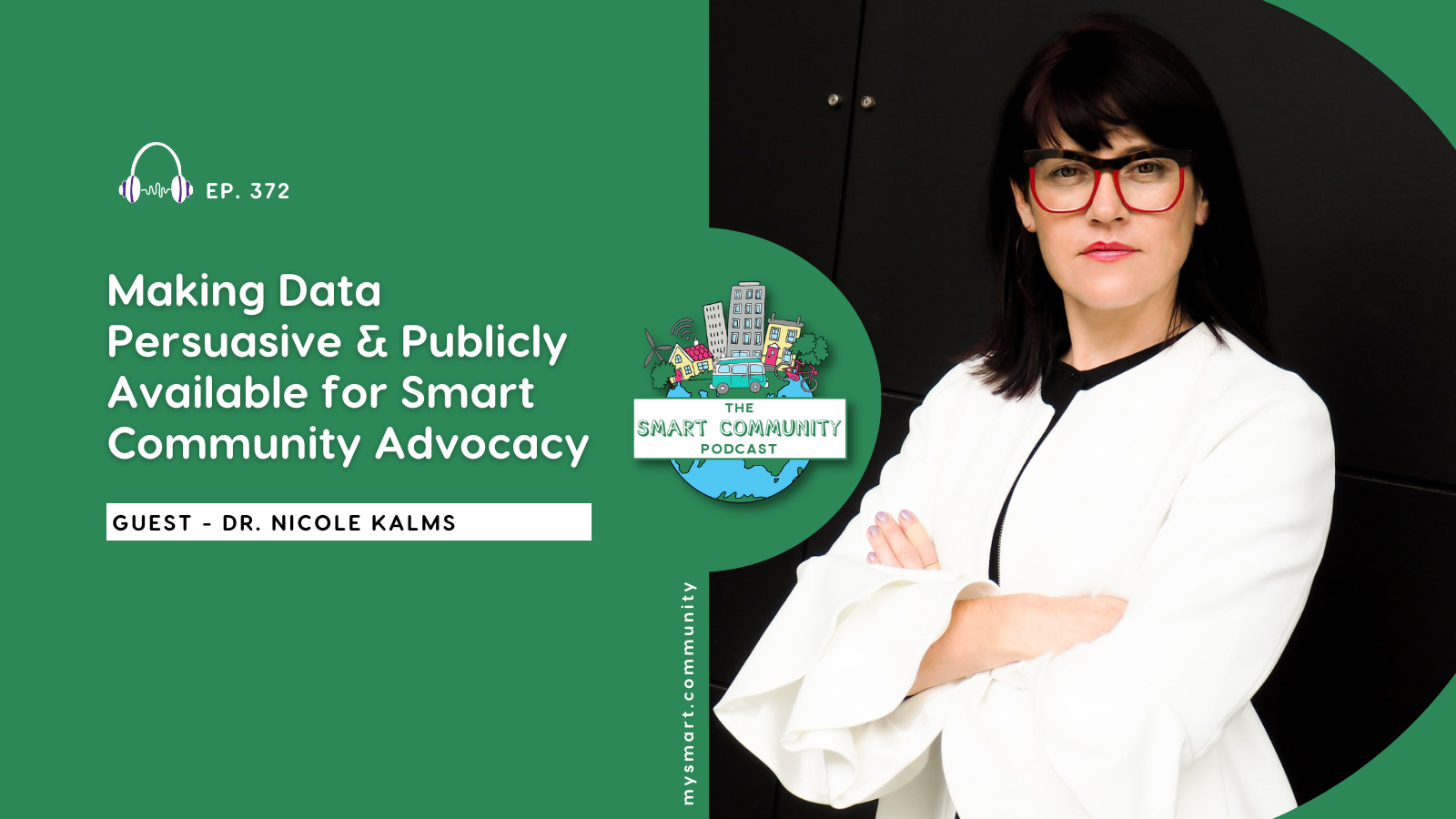
Hi #SmartCommunity friends, in this episode of the Smart Community podcast I have a brilliant discussion with Nicole Kalms.
Nicole is a professor at Monash University and describes herself as a practice-based researcher interested in doing things in the real world. Trained as an architect, she leads the XYX Lab at Monash University, which focuses on gender-sensitive design with a specific focus on public places. Her work examines women’s experiences and the experiences of LGBTQIA+ communities, thinking about how we can make change through design interventions in urban spaces.
In this episode Nicole tells us about mobilising the power of data to intersect with storytelling, particularly around gendered violence and minoritised people’s experiences in cities. Nicole and I discuss the HyperSext City exhibition that uses beautiful graphic design to present confronting data about urban safety, and the YourGround crowdsourcing project mapping safe and unsafe experiences across Victoria and New South Wales.
We talk about the importance of making data persuasive and publicly available, the challenge of balancing aesthetic appeal with difficult content, and the role of design in both data collection and communication. We finish our chat discussing Nicole’s advice about breaking data out of conventions and counting what matters. As always, we hope you enjoy listening to this episode as much as we enjoyed making it.
What we cover in this episode:
- Professor Kalms’ background as a practice-based researcher leading the XYX Lab at Monash University
- How data is often hidden behind paywalls and incomprehensible spreadsheets, limiting its power for advocacy
- The persuasive role of data in confronting people who question whether gendered violence and discrimination are really happening
- The HyperSext City exhibition creating immersive graphic environments using international peer-reviewed data on gender and cities
- The deliberate shock tactics of using beautiful design to present confronting data about horrible experiences in cities
- Cross-referencing intersectional data including age, disability, indigeneity and ethnicity across different urban typologies
- The YourGround crowdsourced mapping project developed with CrowdSpot to gather data on safe and unsafe experiences in public spaces
- Taking exhibitions and data into public spaces through paste-ups during Fremantle Design Week to situate stories where they occur
- How design elements of data collection methods impact accessibility and participation, such as the use of iconography making data collection accessible across diverse language groups and literacy levels
- The importance of making research reports publicly available and communicating findings through multiple formats
- The long-game approach to measuring impact by repeating data collection over 5-10 years to track changes in experiences
- Key challenges around data fatigue, knowing how much challenging information audiences can absorb, and timing of advocacy
- Recommendations including Catherine D’Ignazio and Lauren Klein’s work on data feminism and Kevin Guyan’s Queer Data on queering data as method
Quotes:
“Data [is] often hidden behind paywalls or in incomprehensible spreadsheets… it’s not really that available to public audiences.”
“It’s horrific data about really horrible things that happen in cities, but it looks really beautiful. And so there’s this sense of shock that happens when people really start to understand what it is that they’re looking at.”
“About 50% of what happens for people in cities is related to the behaviour of other people, so what other people are doing or not doing… About 50% is actually about the physical material environment…this is interesting to me because we can shape good and bad experiences through the material public realm.”
“ We’re burdened by being asked to engage with stuff all the time. And so being able to make [data collection] easy and aestheticised and interesting for people is really, really important… To make it really clear and easy is all about design. Now, if you just had a standard questionnaire, nobody is going to give you that information ’cause they don’t have time., and it’s not easy or engaging, or feeling valuable.”
“We’ve got great examples in places like Vienna where they have had those more gender mainstreaming practices in place for decades now or longer. And we do see that gender equity changes, that accessibility and mobility changes, that there are more intergenerational spaces, that there is more diversity of people within public places, because of the built environment.”
“Just because you make it doesn’t mean people are going to look at it. And also, how much can people look at and how much can people take in?”
“ What isn’t counted doesn’t count. And so if there are things that [people] feel are important in the world, in their lives, in their forms of activism, then count it.”
Links:
- Monash University XYX Lab
- HyperSext City
- YourGround Victoria and YourGround New South Wales
- Consenting Cities exhibition
- Data Feminism
- Queer Data
- Dear Data by Giorgia Lupi and Stefanie Posavec
- “Data design and dissemination: visualising gender inequality statistics for public audiences“, Gene Bowden, Nicole Kalms and Isabella Webb in Design Gender Sensitive Spaces for Consenting Cities: Practices and Provocations. Edited By Jess Berry, Nicoles Kalms, Timothy Moore, Gene Bowden, Routledge 2025
Connect:
Connect with Professor Nicole Kalms on LinkedIn or through Monash University and the XYX Lab
Connect with me via email: hello@mysmart.community
Connect with My Smart Community via LinkedIn and watch on YouTube
Podcast Production by Perk Digital
This podcast is recorded on the land of the Kabi Kabi peoples and edited on Gaibal country. I pay my respects to traditional owners of country and their elders past and present. I also extend that respect to all Aboriginal and Torres Strait Islander peoples listening today. Here on the Smart Community Podcast, we talk about data, technology, communities and the future. First Nations peoples have been sharing knowledge, caring for country, and telling stories for tens of thousands of years. I honour that deep connection of storytelling and community connection as we continue our conversation together here today.
Disclaimer
The views, opinions, and perspectives expressed by guests on The Smart Community Podcast are solely those of the individual speakers. They do not necessarily reflect the views, opinions, or positions of the host, Zoe Eather, or of The Smart Community Podcast as a whole.
Any discussion of ideas, products, organisations, or services by podcast guests does not constitute endorsement or recommendation by the host or the podcast. Listeners are encouraged to form their own opinions and seek professional advice where appropriate.